Maple Syrup

Canada-Day-–-Maple-Syrup
The Chemistry of maple syrup

A great infographic from compound chemistry about maple syrup http://www.compoundchem.com

Maple syrup is a sweet tree sap that is high in sucrose and low in other sugars, so it is suitable for the low fodmap diet. Maple syrup may be derived from a natural source but it is still a sugar and therefore should be consumed as a treat – more important perhaps when considering the cost! The syrup has lots of health claims attached to it and has been proposed by some to be a ‘superfood’ and to be superior to table sugar in nutrients. The additional minerals and vitamins that are found in maple syrup, when compared with table sugar, are also found widely in other foods consumed in the diet at much higher levels. So a healthy balanced diet does not depend upon maple syrup to provide vitamins and minerals. Maple syrup also will usually be used in small amounts therefore will not likely contribute massively to nutrient status. There is no such thing as a ‘superfood’- I have stated this before, some of you will be fed up with me harping on about it :-). But I feel an overwhelming dietetic urge to repeat – superfood status is marketing concept to allow a high price to be attached to more unusual food items. Although maple syrup is derived in a way that might attract a higher price than other sugars, I don’t have too much of an issue with this – but please don’t call it super.

Other reported beneficial ingredients in maple syrup are Phenolic compounds, they are suggested to have an antioxidant effect – more evidence is needed to test out this hypothesis. Also, the recent proposed use of Maple syrup in prevention of Alzheimer’s disease, has only been shown in the test tube and animal models and not a randomised control trial (RCT) in humans – the gold standard method. Completing studies in the test tube is very different to the human body, which is much more complex. Therefore much more research in humans should be completed to study the benefits (or not) of the phenolic compounds found in maple syrup.

So my suggestion is – eat maple syrup if you want a low fodmap sweet flavouring and enjoy it for what it is – a flavoured liquid sugar, use it occasionally as a treat. The benefits are of course it’s low fodmap status and it does have a really nice flavour. Should you buy the pure version? Yes, using the pure version is advisable, cheaper varieties can contain fructose based sugars, so you should certainly check the label for ingredients prior to purchase.

Maple syrup is from Canada and is widely used in the United States but it is not so frequently used in the UK. Although with the development of the fodmap diet it is becoming more widely known. It can be used in recipes and goes particularly well with pecans, one of my favourite nuts! It is also commonly drizzled on pancakes and waffles.

What about other tree saps? Well birch syrup is produced from another sap that it harvested  – it contains fructose as one of its main sugars (42-54%) therefore this is not suitable for individuals with fructose malabsorption or on the exclusion part of the low fodmap diet.

pancakes with syrup

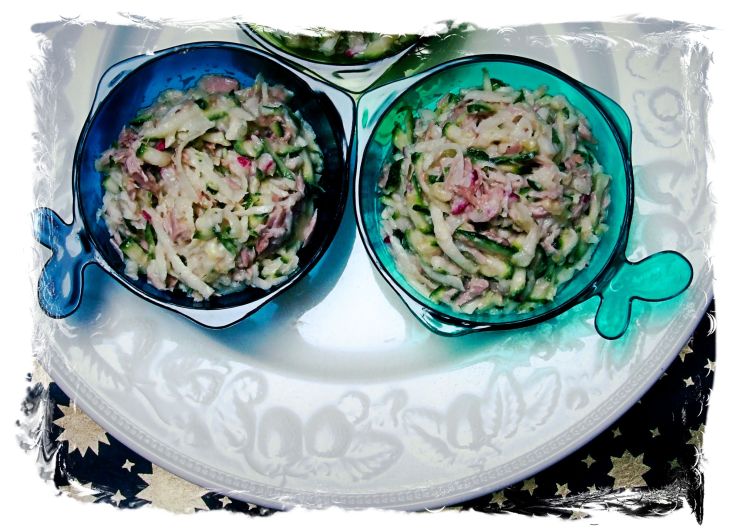
Tuna, courgette and celeriac slaw, Low Fodmap

This recipe can be used as a sandwich filler, topping for jacket potatoes or a salad dressing. Lunch time ideas are very important when following a diet for food intolerances. Being prepared will prevent you needing to buy food that might cause symptoms – or going without, neither of which is a good idea for people with IBS. Celeriac is a much underrated vegetable and I suspect it is the knobbly base that puts some people off using it. It is a root, which has a flavour of celery without the high fodmap content, so if you love celery and are missing it, you might want to try this recipe. Celeriac is easy to prepare really and the knobbly bit can be cut off without wasting much of the vegetable. Another possibility for this recipe is to use is white cabbage, if you can’t get celeriac – although it is generally available at most large supermarkets. Both courgette and celeriac can be eaten raw and the radish just adds a touch of colour to the coleslaw. Celeriac can also be made into a delicious soup, I might try this next!

Ingredients

200g of celeriac

2 courgettes

4-5 radishes

3 dessert spoons of light mayonnaise

1 tin of tuna in spring water or brine (don’t add seasoning if the tuna is in brine, it has more than enough salt!)

2 teaspoons of lemon juice

Seasoning

Method

Grate the celeriac, courgette and radish (you may need to squeeze the courgette to remove excess fluid.)

The lemon juice prevents the celeriac from discolouring.

Add all the ingredients together and mix well – couldn’t be easier!

Serves 4-6 depending on it’s use.

fishslaw5

Interested in home cooking? Do you want to take part in a new TV cooking competition?

Voltage TV are looking for people who are passionate about home cooking for a new BBC2 series to get in touch. This will be the next big TV cooking competition. Voltage TV are looking for Britain’s best home cooks and want to hear from people who are renowned for their home cooked dishes. Do you have family recipe’s that has been passed down for generations? Do you have a different outlook on cooking and eating? Then email food@voltage.tv

Flyer (high_res)

Can you cook a cucumber? British cucumber week

The humble cucumber – stalwart of the afternoon tea finger sandwich has it’s own week, dedicated its summer fresh light green crispness. I find the cucumber a great salad vegetable and obviously it has been used in sandwiches for afternoon tea – a meal that has had a revival recently, but can you use it any other way?

Soup is a good start but what about roasting cucumbers or fried cucumber pasta? I think I might give it a try as the cucumber is a low fodmap vegetable – let’s see what happens!

Ingredients

2 inches of cucumber sliced thinly

1 roasted pepper (sliced)

10 olives

matchbox piece of Parmesan grated

150-200g dried gluten free pasta

1 teaspoon of garlic infused olive oil

Method

Boil the pasta as directed by the packet instructions

Using the oil fry the cucumber, pepper and olives till warmed through

Drain the pasta and combine with the vegetables

Sprinkle with grated Parmesan

Serves 2 – this was very tasty – despite first appearances!

pasta2

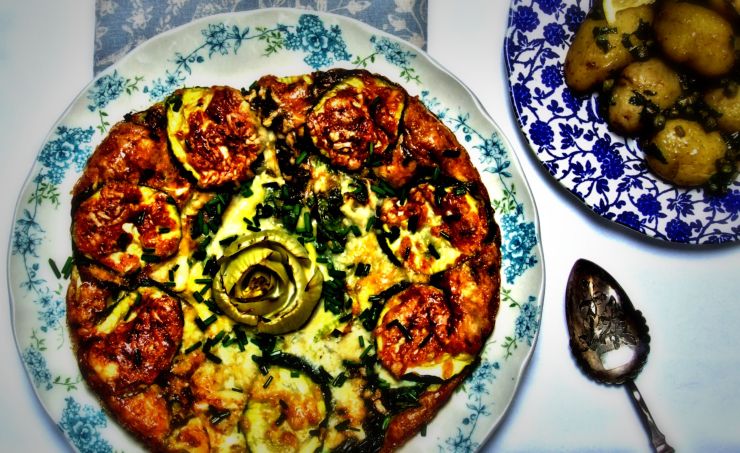
Spring vegetable frittata – low fodmap

This frittata can be served as a light lunch with Jersey potatoes and is very pretty!

Ingredients

5 eggs

Half a sliced courgette

3 Pak Choi

30g of Parmesan cheese

Chives

Salt to taste

Spray oil

Method

Wash the vegetables

Trim the base of the pak choi flat and slice it at right angles to the growth direction, about an inch from the base, to form a flower – do this with each base of the three leaves if you wish – I just used one.

Chop the rest of the pak choi finely.

Slice the courgette.

Grate the cheese.

Whisk the eggs together and season and add the cheese and chopped pak choi.

In a pan add spray oil and place the ‘flowers’ and slices of courgette around the pan.

Add the egg mix to the pan.

Cook until well cooked through

Chop over the chives and serve

Serves 3-4 with Jersey potatoes and green salad.


Which path will you choose?

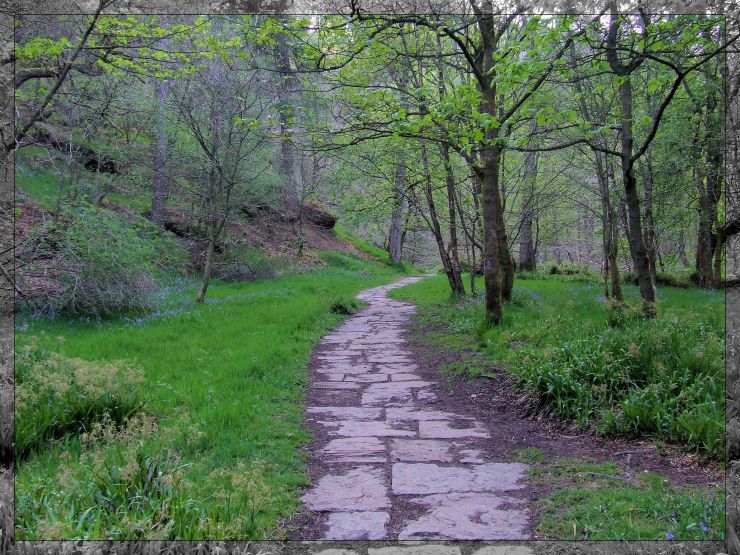
You might consider that this post is not relevant to IBS, but everyone has to make some changes, when diagnosed with a medical condition. Changes perhaps try a new diet, a new medication or treatment, these naturally will require some change to a persons usual lifestyle. I was lucky enough to train with an inspirational dietitian during my clinical placements and one experience I had during training was listening to my mentor explaining to a patient, using the metaphor of a path, for explaining the challenges of changing any behaviour that we need to, in life. She explained that choosing to change a behaviour is like choosing a path to walk and the path we all use as a default, as human beings, is often the easy, well trodden route. Or the path of least resistance. This is a human trait – it is certainly not being lazy, a comment I often hear from people – you are not lazy – you are human. Making changes is challenging, a difficult path to follow, often with steep slopes, an uneven, meandering, overgrown path – a formidable terrain. Initially both paths follow close to each other.

Often, when starting out on a demanding route, it is very easy to start to follow the more difficult path and step from the difficult route back to the easy one. This is very much to be expected – but when this happens, look behind you – how far have you come? You now have a decision to make – and this decision is solely yours, so take full ownership of it. You can continue to follow the well trodden route, consider what this will ultimately achieve – weigh up the costs and benefits of staying on your chosen path. If you choose to stay on the well trodden path then do not feel disappointed, don’t berate yourself for your choice. You have made a choice and there will be very good reasons for it. Maybe this is not the time for difficult challenges and believe it or not, it is perfectly acceptable to reach such a conclusion. Walk a little further and consider again whether you are ready to try the more difficult path, it will always be possible to step back onto it, from the easy route. People can hop from one path to the other a few times before they find that they are actually some way down the tough route and realise that the path actually does have very manageable sections. Now the easy path is some way in the distance and this tougher path has surprisingly become the new default. Think about the achievement you can make and the views you can expect to see, when following the challenging paths in life!