Lamb wrapped in kale

Kale is tough, stringy and overtly pretentious, but it looks really great in photographs – perhaps the reason most ‘wellness’ bloggers overstate it’s usefulness. The real deal with kale is however it is low fodmap and really great for making parcels to cook other food. Using kale to produce a parcel to roast meat is that it cooks for longer in the oven helping the leaf texture to soften. It also holds in the juices of the meat. I love the colour of this kale – purple and green is my favourite and when served with chard the result is a veritable rainbow! So there we have it – all kale is really useful for is wrapping! Unfortunately this method of cooking will not preserve its water soluble vitamins, I for one would prefer to get my vitamin C from citrus fruit, rather than chomping on a kale leaf.
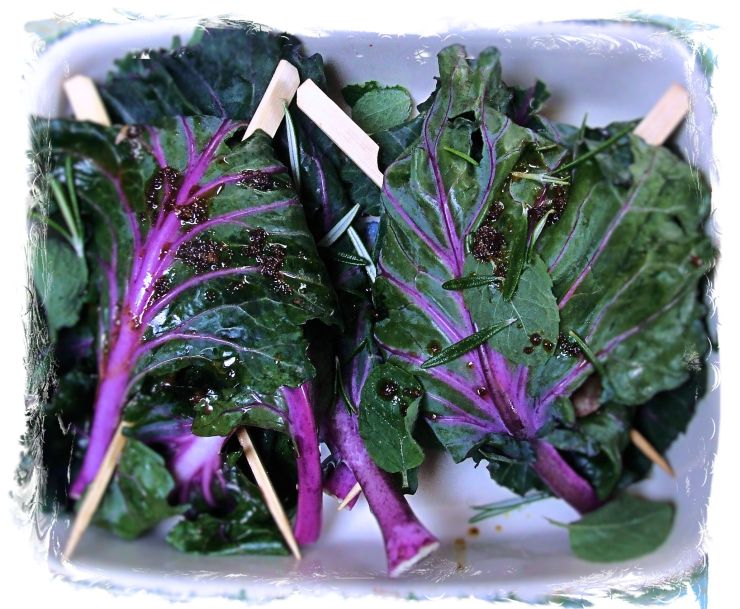
lamb-wrapped-in-kale

Ingredients

2 small lamb steaks – I used slow cook lamb

A few sprigs of rosemary and mint

1 teaspoon of Moroccan spice (Fodify Foods Moroccan mix is low fodmap and was purchased by me.)

Seasoning (small amount of salt + pepper)

Small drizzle of oil

Sprinkle of pine-nuts

Kale leaves

Skewers to secure the leaves around the meat.

Carrots for roasting and chard to serve alongside.

Method

Add the oil and spice to a pan and heat.

Seal the meat using the oil and spice mix, season.

Wrap each lamb steak in kale leaves, additional herbs and secure with the skewers. Ensure you add all the oil/spices left in the pan for additional flavour.

Roast in an oven gas mark 3 for at least 2 hours (depending on the size of your meat.)

Allow the meat to rest for 10 minutes then serve on the kale sprinkled with a small amount of pine-nuts.

Carrots spray with oil and roast till soft, I like these really cooked well so they develop sugary flavours and are crisp at the end. The dark ones are purple carrots! You can serve chard cold but it does taste great quickly sauteed, again with a little spray oil.

pictureframelambkale

Maple Syrup

Canada-Day-–-Maple-Syrup
The Chemistry of maple syrup

A great infographic from compound chemistry about maple syrup http://www.compoundchem.com

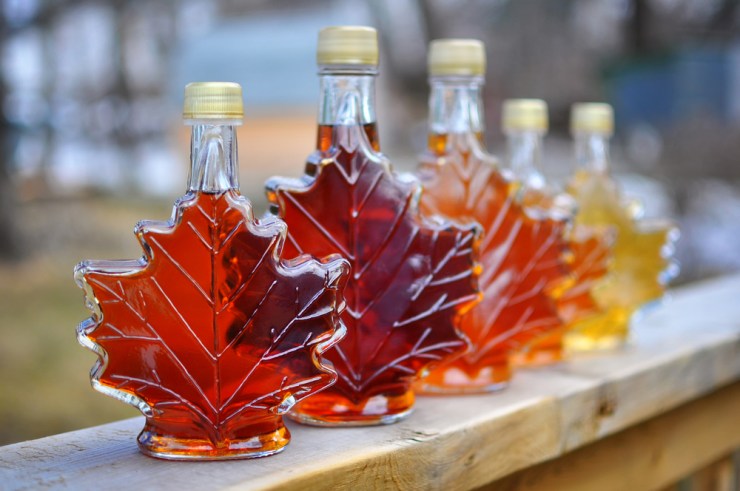
Maple syrup is a sweet tree sap that is high in sucrose and low in other sugars, so it is suitable for the low fodmap diet. Maple syrup may be derived from a natural source but it is still a sugar and therefore should be consumed as a treat – more important perhaps when considering the cost! The syrup has lots of health claims attached to it and has been proposed by some to be a ‘superfood’ and to be superior to table sugar in nutrients. The additional minerals and vitamins that are found in maple syrup, when compared with table sugar, are also found widely in other foods consumed in the diet at much higher levels. So a healthy balanced diet does not depend upon maple syrup to provide vitamins and minerals. Maple syrup also will usually be used in small amounts therefore will not likely contribute massively to nutrient status. There is no such thing as a ‘superfood’- I have stated this before, some of you will be fed up with me harping on about it :-). But I feel an overwhelming dietetic urge to repeat – superfood status is marketing concept to allow a high price to be attached to more unusual food items. Although maple syrup is derived in a way that might attract a higher price than other sugars, I don’t have too much of an issue with this – but please don’t call it super.

Other reported beneficial ingredients in maple syrup are Phenolic compounds, they are suggested to have an antioxidant effect – more evidence is needed to test out this hypothesis. Also, the recent proposed use of Maple syrup in prevention of Alzheimer’s disease, has only been shown in the test tube and animal models and not a randomised control trial (RCT) in humans – the gold standard method. Completing studies in the test tube is very different to the human body, which is much more complex. Therefore much more research in humans should be completed to study the benefits (or not) of the phenolic compounds found in maple syrup.

So my suggestion is – eat maple syrup if you want a low fodmap sweet flavouring and enjoy it for what it is – a flavoured liquid sugar, use it occasionally as a treat. The benefits are of course it’s low fodmap status and it does have a really nice flavour. Should you buy the pure version? Yes, using the pure version is advisable, cheaper varieties can contain fructose based sugars, so you should certainly check the label for ingredients prior to purchase.

Maple syrup is from Canada and is widely used in the United States but it is not so frequently used in the UK. Although with the development of the fodmap diet it is becoming more widely known. It can be used in recipes and goes particularly well with pecans, one of my favourite nuts! It is also commonly drizzled on pancakes and waffles.

What about other tree saps? Well birch syrup is produced from another sap that it harvested  – it contains fructose as one of its main sugars (42-54%) therefore this is not suitable for individuals with fructose malabsorption or on the exclusion part of the low fodmap diet.

pancakes with syrup

Celeriac Soup – low fodmap

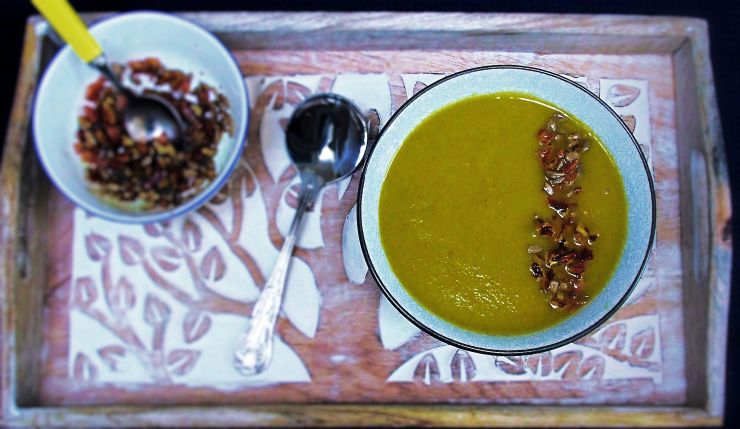
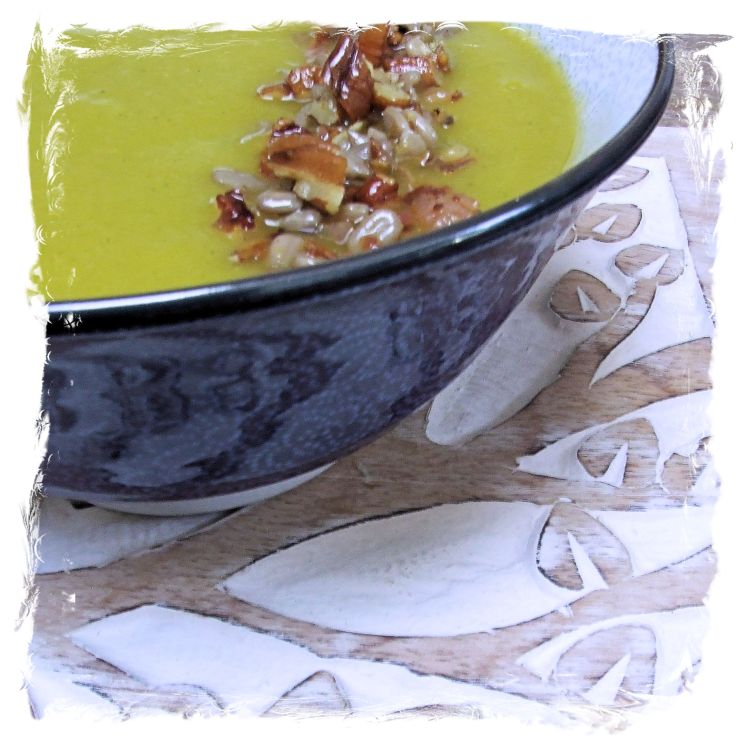
I have half a celeriac left so as promised I have made a soup. This was very easy to do and is based on home made chicken stock and has a topping based on bacon, pecan and sunflower seeds. If you want a vegetarian version just omit the bacon and chicken stock and use vegetable stock instead. I really like soup, it is filling and yet low calorie and this soup has a very refreshing flavour due to the added tarragon.

Ingredients

Half a celeriac

1 courgette

2 carrots

A small cup of home made chicken stock

2 teaspoons of chopped fresh tarragon (use one if dried)

1 pint of water

Seasoning to taste

For the topping

1 rasher of bacon

1 tablespoon of sunflower seeds

1 tablespoon of chopped pecan nuts.

1 teaspoon of vegetable oil

Method

Chop vegetables and add stock, water and tarragon and bring to a boil then simmer for 20 minutes till the vegetables are soft.

Blend

Chop the bacon after remove fat and rind. Fry the bacon in a teaspoon of oil, add the pecans and sunflower seeds and toast.

Sprinkle on the top of the soup and serve

Serves 2-3

celeriacsoup1

Tuna, courgette and celeriac slaw, Low Fodmap

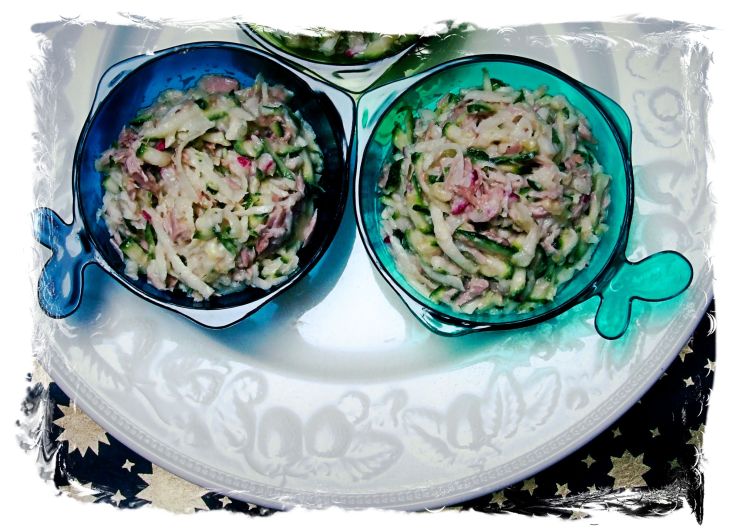
This recipe can be used as a sandwich filler, topping for jacket potatoes or a salad dressing. Lunch time ideas are very important when following a diet for food intolerances. Being prepared will prevent you needing to buy food that might cause symptoms – or going without, neither of which is a good idea for people with IBS. Celeriac is a much underrated vegetable and I suspect it is the knobbly base that puts some people off using it. It is a root, which has a flavour of celery without the high fodmap content, so if you love celery and are missing it, you might want to try this recipe. Celeriac is easy to prepare really and the knobbly bit can be cut off without wasting much of the vegetable. Another possibility for this recipe is to use is white cabbage, if you can’t get celeriac – although it is generally available at most large supermarkets. Both courgette and celeriac can be eaten raw and the radish just adds a touch of colour to the coleslaw. Celeriac can also be made into a delicious soup, I might try this next!

Ingredients

200g of celeriac

2 courgettes

4-5 radishes

3 dessert spoons of light mayonnaise

1 tin of tuna in spring water or brine (don’t add seasoning if the tuna is in brine, it has more than enough salt!)

2 teaspoons of lemon juice

Seasoning

Method

Grate the celeriac, courgette and radish (you may need to squeeze the courgette to remove excess fluid.)

The lemon juice prevents the celeriac from discolouring.

Add all the ingredients together and mix well – couldn’t be easier!

Serves 4-6 depending on it’s use.

fishslaw5

Herding cats – the challenges of probiotic research in IBS.

I was very pleased to be part of the development process of the dietary guidelines for IBS that were published in 2016 with some very experienced dietitians. The paper on probiotics I was involved in was a really great way of learning about this subject area and also the complexities of developing probiotic products. The perhaps unsurprising result of the systematic review meant that the evidence base for these products was not strong enough to allow us to advocate one probiotic product for IBS. However the Ford (2014) review with meta analysis (a calculation used to show whether combining controlled treatment trials are effective) showed that overall probiotics are effective. A more recent guideline publication in 2021 from the British Society of Gastroenterology, guidelines for IBS, also suggest that they can be tried, however the American Society of Gastroenterology do not recommend them. This is confusing for people. I do feel the UK position on the products is the correct one – if people wish to try them they can and it is perhaps better to choose one that has had some research. I am also aware that whilst the effectiveness of the products do vary, where they do work they offer a treatment option for people with IBS.

The variety of formulation possibilities of a probiotic product means that it would be unusual for a new product to be the same as one that has been previously developed. Heterogeneity of these products is a big problem, imagine you are a manufacturer, you don’t necessarily want to go over old ground as the expense of development and research is high and you want to fund research to showcase your new product. Research in industry is about marketing and the product, you want to recoup your investment.

But repetition is exactly what is needed to strengthen the evidence – more papers showing effectiveness for one product. A generic medication, where choice of how to produce the medication formulation is likely limited by the chemical nature of the active ingredient, perhaps meaning the tablet excipients do not vary overly much. The result is you can have many published papers for one medication, a position of strength. Probiotics, on the other hand, can be added to a food, and should be classed as a functional food, which is chemically complex and varied. Not that I lay the blame solely at the door of the manufacturers, the choices they have when considering new developments are enormous – to include one or many probiotic species, to have a tablet, yoghurt of fruit juice drink? What is the likely shelf life, when do you take it – with food, after or before? Does it survive to the digestive tract? Does it need too? (Enck 2008 denatured their probiotic before its use) What dose to include? (This was tested by Whorwell in 2006 – three doses and only one proved to be marginally effective.)

Are we looking at a food or a medication? As I have stated above probiotics should be classed as a functional food. Randomized controlled trials are a very good method of researching medications, but not necessarily diets, which are overly complex and difficult to randomise. However, this is the best method we have and is a requirement for a good evidence base, so clearly needs to be used.

Confounding variables (a factor that is not under study that can vary and influence the final result) are vital to be considered and ruled out. In probiotic research, when we a researching a food item, we should ensure participants diets do not change and influence the final result. The more understanding we have in how our diets influence our own microbiota, which has improved over the past few years, the more important this variable is becoming to the methodology. So it needs to be considered a part of the methodology and shown not to change throughout the duration of the study.

We have a varying medical condition – IBS, IBS-C, IBD-D, IBS-M and IBS post infection – could these possibly be distinct groups? Treatment for one type of IBS also might result in swinging symptoms to another type – changing bowel function for sure, but the patient feels no better. Quality of life is very important and certainly should be part of the measures used, testing has used a variety of different validated tools to assess this important factor. Also, measuring tools for IBS are often not standardised, all of these factors make for poor results.  We also have Rome IV, which has removed the term ‘discomfort’ from it’s diagnostic criteria, reducing prevalence of IBS overnight – it is going to be very interesting to see what effect this has on future treatment research.

Numbers of participants in studies are often low, meaning that the studies should be defined as pilot studies – this results in a positive effect being overly positive (p values will be likely closer to 0.05 for higher numbers of included participants, if you have a p value of 0.001 check out the number of participants – if you have over a hundred this is a good result! If you have 10, maybe not so great.) We do need over 100 patients to make good research in IBS.

We also have a situation where some probiotics that have two RCTs – often with conflicting results, how is this possible? We are likely comparing two ‘moving targets’ both with high heterogeneity – my personal view is that research in probiotics and IBS is a little bit like herding cats – a very big challenge. When herding cats, the method used is vital to the success of the job and probiotic research is no different in this. The methodology, whilst has improved over the last twenty years, needs to be further tightened up, I’m afraid.

One topic that is often mentioned in IBS research, is placebo effect, this is reported to be high, anywhere from 30-50%. So, to know if the product is actually effective you need to test whether the result gives an improvement of over this percentage, from baseline. Not many are. But is this an issue? Maybe not if the patient feels better that is a result, we need to consider the patient in our assessment of the evidence too.

This is where we are, considering the patient. Perhaps the fact we have any studies showing a positive effect is nothing short of a miracle considering how difficult this research is to undertake. Standardizing the process will produce better results and should certainly be considered. Drivers for the probiotic industry are the ability of using a health claim on their product, EFSA have still declined to confer this privilege to any probiotic product. The one manufacturer that does achieve this status is likely to be a market leader, using good methodology is key to this process, in my humble opinion. However we have a duty here to people with IBS and perhaps taking a pragmatic approach is best, as overall the evidence by meta-analysis suggests that probiotics are effective. We should publish where the evidence is best to help patients to choose the best option, if they want to try these products. It might not help all symptoms, but the patient should choose the symptom they wish to reduce and go with the product where the evidence is weak.

My own toe dip into herding the evidence of RCTs into a systematic review proved how much of a challenge this is, numerous hours (immeasurable) pouring over data proved to be a interesting way to learn about these products. Hopefully this effort will result in some improved data and improved results in the future.

If you wish to try a probiotic then you should try it for 1 month to 3 months (the British Society of Gastroenterology guidelines suggest 3 months and some dietitians feel this is a better length of time to try too, but most research studies are only done over 1 month.) If it works you need to continue to take it, as there are few long term studies to check whether the products repopulate the gut. Cost should be considered and as the microbiota profile varies considerably between one person and the next, one may not work and another might – unfortunately it is a case of trial and error with these products. Check out the links below for products that have some research.

If you wish to look at the papers yourself the links are below, and if you are a healthcare professional the probiotics paper contains a really good chart that can be used in a clinic situation. Download your copy today!