Day 3 – getting complacent?

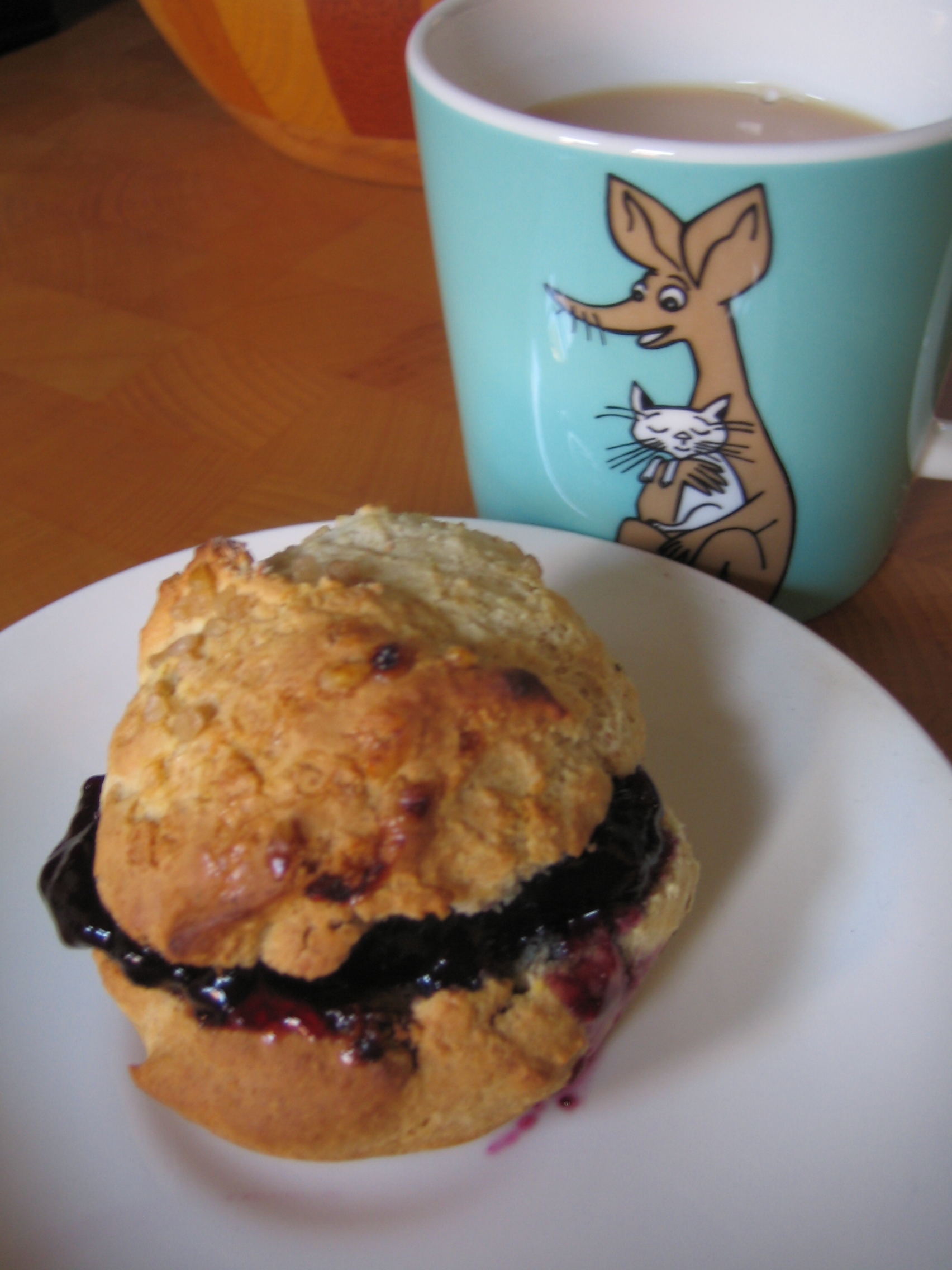
Just look at my scones, aren’t they just perfect? Guess what? I made them without the recommended 28g of oil – so slightly lower in fat too, so I’m not just thinking of gluten-free now, but healthy eating – multi tasking diva, lol! They were from a packet mix so I suppose I cheated a little but so what? Just a good food for a treat, they are a little better having been made for a day and they don’t have the ‘bicarbonate’ taste you sometimes can get after eating scones. So all good then?

Well, perhaps I speak too soon – all was not perfect with the pasta I made for my lunch. I followed the instructions on the packet. I always tell people to do this, since a previous experience of ending up with a lump of starch once when preparing gluten-free pasta. I was stirring the pan as advised as tasted the pasta which was a little too al-dente, then in a matter of seconds it went very mushy. I have still prepared my pasta salad for lunch so I will report back how this tastes later today.

I’m up early today, bright-eyed and bushy-tailed and ready for whatever the day may bring. Reflecting on things this morning and I do feel that it is really important as a dietitian not to impose your food likes/dislikes on others, I have always been somewhat aware of this when I recommend sip feed drinks to patients but also in clinic. I recommend those people who are newly diagnosed coeliac, it is really important to try as many different foods as possible as we all like different food. I may not like many of the gluten-free biscuits, for example, but others may – so I would advise to try again with foods if you are struggling with. So don’t let my feelings on gluten free biscuits cloud your judgement, they are worth trying for a treat. This is also good advice for people who have been coeliac for a number of years and who are stuck in a rut of eating the same food all the time – my experience over the past few days is that even in a short period of three years the choice of gluten-free food has improved significantly.

Day 2 and Counting – no near misses today

Made it – day two, no near misses, up to now, at least! So I had the same breakfast as yesterday, which I am still enjoying – not like my foray into gluten-free in 2009 – I’m unsure what has changed perhaps it’s my improved knowledge of the diet.

My lunch is shown on the right, it consisted of

1 fillet of smoked mackerel

1 boiled egg

5 radishes

2 celery sticks

2 inch slice of cucumber

5 mushrooms

and 2 slices of my wonderful (?) gluten-free bread

Unfortunately I forgot to take some fruit with me today so I arrived home ready to devour ANYTHING,  I would have eaten a scabby donkey if one were available – they are gluten-free :-). The one problem with the gluten-free diet if you are not used to it planning is needed. What to have for my meal? Whilst preparing my meal I had 2 small gluten-free corn cakes and a banana.

My bread has gone stale now – so ready for toast, 2 slices of bread (or brick – which describes it a little better!) with Edam and some ham (packet ham – avoiding contamination.) I did really enjoy this and it has filled me up. The gluten-free carb foods do fill me up I wonder if that is because they can be higher in fat to improve the texture? I don’t think my bread will last another day so I have wasted that mix, about 1/3 of a loaf, I might try freezing some next time, but I don’t think I have enough mix left to make another loaf.

The good thing about following the diet is that I can’t have any biscuits – My one and only weakness!! 🙂 I am going to try to make some scones now – so watch out for another culinary disaster.

‘G’ day – day one on gluten free diet.

Day one – the gluten-free challenge – how is it going? Well fine actually – I have done good so far, but less than 24 hours in so perhaps that isn’t too surprising. Nearly had one mishap this morning though, or what would be classed in the health service as ‘a near miss incident!’ My alarm clock decided to ring VERY early – I don’t know why, this woke me up, disturbed my sleep and when I eventually managed to drag my body out of bed and go down for breakfast, I reached in the cupboard and took out the box of cereal that is too high in barley malt – poured a bowl – then realised. Had to put the cereal back in the box and get a new bowl. Opened the gluten-free cereal and had that with skimmed milk, a handful of raisins and two tablespoons of gluten-free cherry yoghurt – nice!

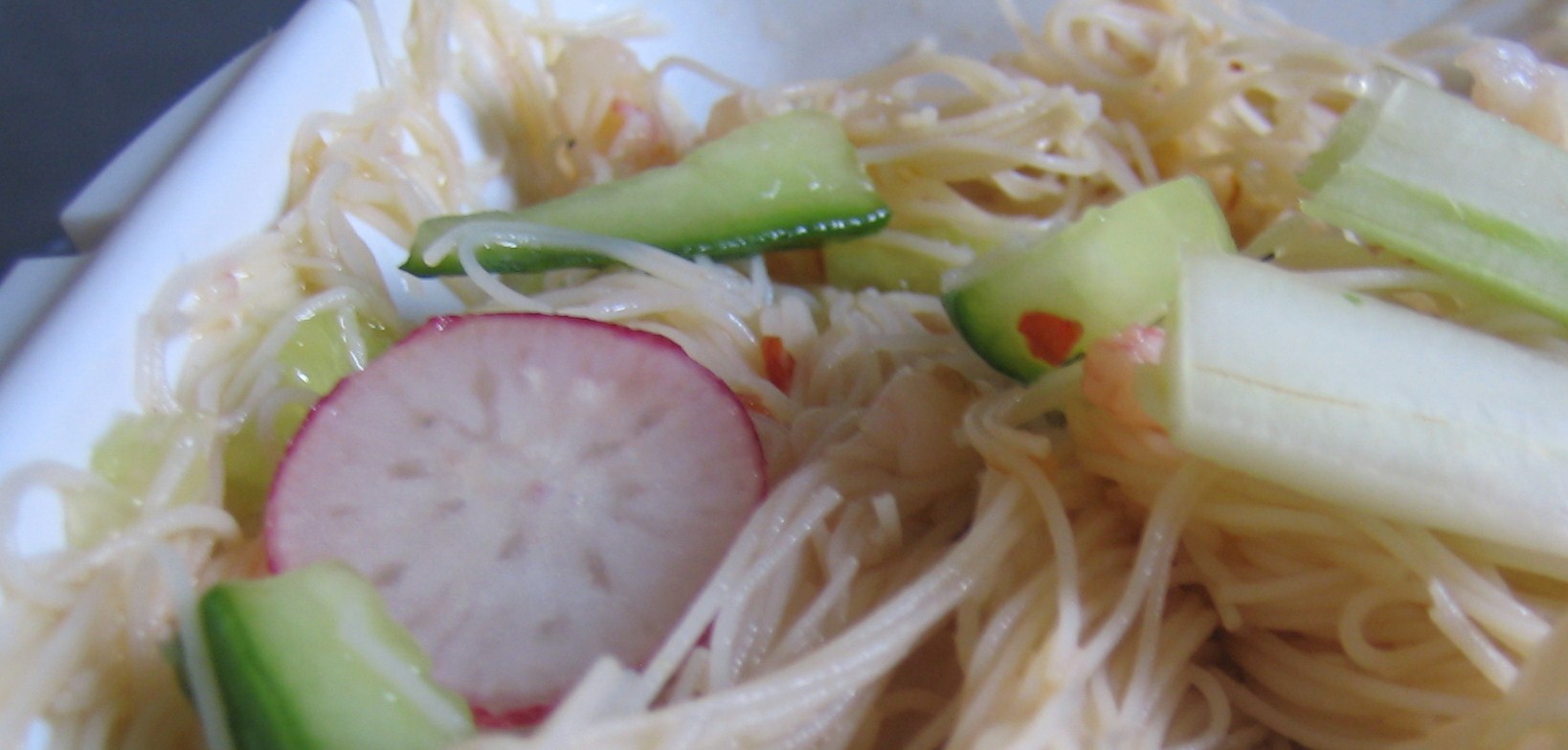
The picture above was my lunch consisting of

1/2 packet of brown rice fine noodles – pour on boiling water till soft, then drain and cool.

2 inch slice of cucumber – cut lengthways

100g prawns

2 sticks of celery – cut lengthways

2 radishes (for colour)

2 tablespoons of gluten-free sweet chilli

Mix well

I had this with 1 apple and 1 banana.

Waiting now for my evening meal of jacket spud and gluten-free baked beans – yum!

Last night I emailed the hotel and requested a gluten-free breakfast – they were very fast in responding, but I also need to ask them to bring my breakfast separately should it be a free for all buffet – breadcrumbs included! 😦

This is what I requested – we will see what happens, although it might be difficult to tell if some contamination has occurred 😉 but this is no different to what some people will experience.

Dear Sir/Madam
I have a reservation on the 17th and 18th of May and I am sending this email to request a gluten-free option for breakfast, if you would be so kind to provide this. This is required because of coeliac disease and consuming gluten can make me ill, should you need more information on how to provide a gluten-free diet please check the following link, which will take you to coeliac UK’s website where you can find further information. It is important that any contamination with gluten during preparation and cooking is avoided, this can sometimes be a problem. I am more than happy to answer any questions, or check foods for you, should this be needed.
If you can’t provide a gluten-free option I will bring my own cereal, so please let me know if this request is problematic.
Thank you
Tummy rumbling now – need my meal
Will blog again tomorrow!

Less than 24 hours to G Day!

I have been challenged to have another try at following a gluten-free diet by Coeliac UK Wessex, to see what changes have come about in the last 3 years, I am aware of the changes as I do have to advise people, but as I have blogged previously – nothing like ‘living it.’ This time to make the challenge a little more difficult I am going to the Allergy & Free From show on Friday and Saturday necessitating a hotel stay and no doubt two days of eating out and all the difficulties that may present.

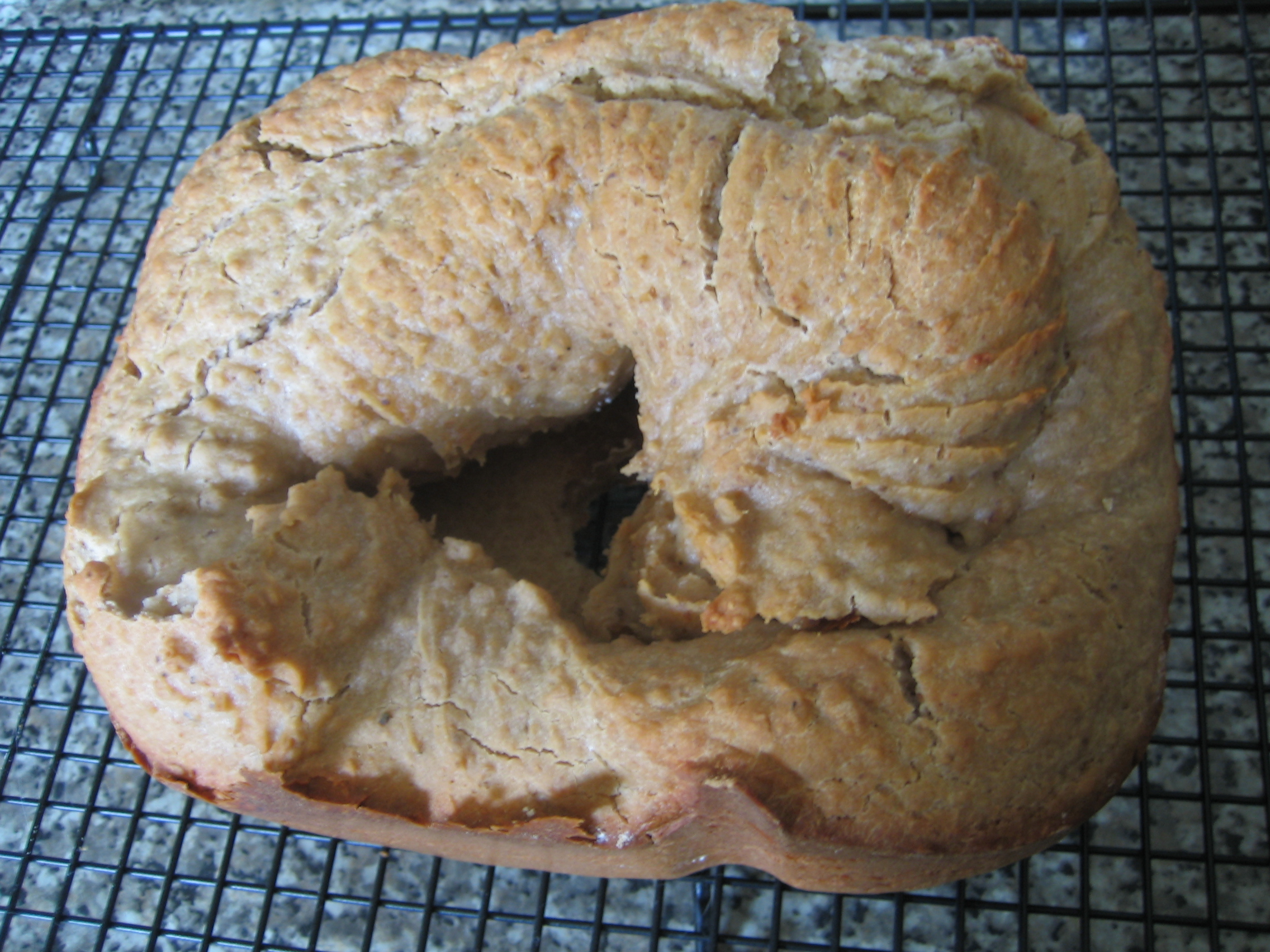
So with less than 24 hours to go to G day (gluten-free day 1) I have been preparing – I have to say I am a little more comfortable in following the diet this time as I am very knowledgable about what the requirements are, much less daunting than my first foray in gluten-free living. I have made my bread (see attached picture) not a pleasant sight, but very tasty non the less ;-). I have a fridge full of naturally gluten-free salad and fruit and I have planned what I am going to eat. The one thing I am finding a little unsettling is the fact I am going to have to contact the hotel to request a gluten-free breakfast – this is a little fraudulent, I feel, as I don’t have coeliac disease, but it is necessary to immerse myself fully in the experience. I am going to have to open a new box of rice breakfast cereal (as the one we are currently using contains greater than 100 ppm of gluten – as barley malt) and a new jam pot (to avoid contamination) and prepare my meals for work, I am actually looking forward to the experience. My lunch has been made for ‘G day’ brown rice noodles, gluten-free sweet chilli sauce, prawns, cucumber and celery salad and I have planned to be able to have a yummy breakfast with rice cereal, gluten-free cherry yogurt and some dried fruit (containing iron and calcium.) Wish me luck – will blog again tomorrow 🙂

Self care for your irritable bowel – worth a look?

This month The IBS Network launched is new interactive on-line self-care plan for IBS, you may be wondering what it’s all about, and possibly not being a member you wouldn’t have access to it to try it out. Well, this blog will give you some more information to allow you to make your mind up before taking the plunge. Some questions you may be thinking of:

Why should I take responsibility for my IBS – surely I pay my taxes or health insurance to pay doctors to sort this out for me? 

So, has this happened then? If your IBS has been helped you probably wouldn’t be looking for answers. IBS is a chronic condition that is poorly understood by the medical profession, and they freely accept this is the case. This condition is very similar to other misunderstood syndromes such as chronic fatigue and fibromyalgia, IBS is a problem of how the digestive system functions, or moves – looking at it using tests and instruments doesn’t lead to a diagnosis, as there is nothing yet that can be seen. This is either because it is caused by something that researchers haven’t yet found or it is purely a dysfunction in the way the gut moves (think of it as being similar to the different speeds your heart can beat.) It does not mean that it’s all in your head, or you do not feel pain or you do not suffer from difficult diarrhoea or constipation. The plan can give you information that will help you think of what else it could be, but sometimes accepting IBS for what it is will allow you to move on and try to help yourself. Everyone’s IBS symptoms are different, you are best placed to be able to help with your own IBS as you understand what makes your IBS flare up.

But I don’t understand what affects my IBS – it’s so complicated! 😦

This is where the self-care plan can help, you can use the symptom tracker for two to three weeks, it is a simple tool that helps you log areas that affect your IBS such as life events, diet, medication, disturbed sleep and exercise. We have kept it fairly simple so that you can focus on general areas initially making it easier to design your self-help package. You can then print a report that will show you when you feel better or worse and what happened to cause a change. This is also a very good report to take along to your healthcare provider, to help them to identify the best course of treatment for you.

For example – So my symptom checker has shown that every time I eat pasta I feel worse and every time I have a meeting with the MD at work I get diarrhoea. You can then use the information contained in the plan to check out how to change your diet to help you feel better and what can be done to relax before your meeting or what medications may help you.

This is fine to talk about but I find it really difficult to change my life!

The answer to this is we all find it difficult to change from time to time. Make one change at a time if you can, this will make it easier for you to use your symptom tracker to see if the change has helped – be SMART with your changes

Specific goals – makes them easier to manage. e.g. “I wish to reduce my levels of stress”, this is not specific enough, how are you going to reduce stress? By doing what?

Measurable – you need to be able to see the effect to feel really great about your achievement – use your symptom checker, or a food & mood diary.

Achievable – How are you going to make the change? Try to choose parts of your plan to change that you feel are much easier to achieve, this will give you lots more confidence to try the harder changes. For each change ask yourself the following question

‘on a scale of 1-10, 1 being very easy and 10 being very difficult – what would I score the ease of making this change?’ Try the ones that score lower initially.

Realistic –  Think about if you can really achieve what you have planned – if it’s just too difficult to do, you will be setting yourself up to fail. Sometimes we can’t change some aspects of our lives, it is fine to accept this and PUT IT TO ONE SIDE, don’t keep focussing on what you can’t achieve. Another question to ask would be, is it the right time for me to make this change?

Time focussed – how long is it going to take? It may take a minimum of three weeks to change some aspect of your life and thinking how long you will need will help you to keep focussed.

Changing our lives, what we eat or how much exercise we do is a challenge, we all behave in a way that makes it easier to live our lives, but think about your symptoms – if you always do the same thing you will always get the same result – ask yourself do you want this to continue? what are you gaining from your IBS? What will changing mean? The care plan will help you think about your IBS and it contains exercises to help you understand your condition. Changing can take time and lapses are to be expected, it is what you do about a lapse that’s important – don’t put yourself down and feel a total failure, put it behind you as something that has happened (and was probably likely to happen!) and try again – small steps! Think and plan what you would do if you have a lapse in your planned changes before they happen and this will help. Don’t allow a lapse to become a relapse. Also plan to reward yourself when you reach each goal this will positively reinforce the changes you have made.

I have heard that having a practitioner actually helps with IBS? How will helping myself work?

All the information contained in the care plan has clinical evidence or experts in health have come to a consensus through experience that the information will help – we don’t yet have evidence that the self-help plan works as a whole, as it has only just been developed – this is something we hope to prove when people are starting to use it. There is a study that on-line self-help for other chronic conditions such as chronic fatigue* works, and whilst this doesn’t directly relate to IBS, with 10 – 20% of the population diagnosed a new way of helping needs to be developed.

If you are interested in the plan follow the link on the right hand side of this page or copy and post the following link

http://www.theibsnetwork.org

*Nijhof, Bleijenberg, Uiterwaal, Kimpen, Putte (2012) Effectiveness of an internet based cognitive behavioural treatment for adolescents with chronic fatigue syndrome (FITNET): a randomised controlled trial The Lancet published on line March 1, 2012

A dietitian’s reflection on following a gluten free diet

Copyright (c) 2012 Jules_GastroRD.
Permission is granted to copy, distribute and/or modify this document
under the terms of the GNU Free Documentation License, Version 1.3
or any later version published by the Free Software Foundation;
with no Invariant Sections, no Front-Cover Texts, and no Back-Cover Texts.
A copy of the license is included in the section entitled “GNU
Free Documentation License”

When I initially became involved in treating people with coeliac disease I decided that it would be good to try to follow the gluten-free diet to see what the problems were, this post is a copy of my reflection and was originally written in 2009 – some of the issues I experienced will not have been made any easier in the current economic climate. I feel the need to share this with you – I may try to persuade you to continue following your gluten-free diet to ensure optimum health, but I do appreciate this is no mean feat to achieve!

I REALLY like bread and my favourite meal of the day is breakfast when I have a bowl of cornflakes (what??? a dietitian not eating a fibre based breakkie? – let me assure you, I do eat plenty of fibre :-).) I have some experience of changing my breakfast cereal for unnamed brands to try to save money and I have to say I failed miserably, as many brands fail to keep their texture once in milk and often taste very bland. I therefore eat a certain very well-known brand of cornflakes. As such I was not looking forward to the experience of having to change, but I felt it was worthwhile.

I began by purchasing the prescription breads, rolls, pitta breads and some breakfast cereal. I cut the rolls without refreshing them and they just crumbled and were unusable, so I learned very quickly to refresh bread before doing anything with it. The homemade bread in the bread maker was significantly better than pre made bread (as the latter was powdery and not helped by the fact that I do not generally use any spread on my bread.) I could also add seeds and dried fruit to this to increase the fibre content, as I have also learned that despite the flour being marketed as fibre based the levels are still lower than the equivalent wholemeal bread I normally consume.  Regardless of consuming in excess of five portions of fruit & vegetables a day and plenty of fluids, this diet resulted in constipation, so as you can probably imagine – I was not a happy bunny (with stools to match!)

I decided to purchase everything that I used to see what difference it made, the diet is very expensive and Coeliac UK surveys suggest that it adds ten pounds to a shopping bill (don’t forget this was written in 2009) despite foods being available on prescription, as food prices have increased since then, this data is probably now a conservative estimate. This may result in people with coeliac disease not purchasing gluten free foods and this is particularly relevant at the moment, as many people are managing on very tight budgets. One issue that did vex was that many foods in the dietary allergy section of the supermarkets are expensive, often ORGANIC (this is a luxury lifestyle choice in my view, and might pander to those who manipulate their diet by choice, and not medically evidenced/diagnosed as required, often these individuals can afford to spend more on their diet. Although – why shouldn’t people with Coeliac Disease have a choice of organic you may ask? – that’s fine, as long as there are also standard alternatives available.) The problem is, when newly diagnosed coeliac, and not used to using the Coeliac UK food directory, people will obviously choose foods that are easily identifiable, as they must have something to eat. This may well be in these specialist sections in the supermarket where 1/ not everything may well be gluten-free, as the section is for all food intolerances (still need to use the gluten free food directory) and 2/ cheaper gluten free versions might be available in the rest of the store (again looking at the directory will help.) I found the most time effective way of doing this is to write the usually consumed foods on a list and to either do a search on the Coeliac UK online food directory, or match the foods from the directory in the store that is used, prior to visiting the supermarket.

Initially my breakfast was a huge disappointment, the first cereal I purchased was an organic gluten free cereal flakes that was at the allergy section of the supermarket, it was extremely expensive, and as I normally consume a large bowl it only lasted five days. Reducing the portion size resulted in hunger so I then had to add a slice of gluten free toast and jam. This cereal tasted good, but I obviously couldn’t afford to continue using this. The same supermarket had cornflakes available in their own brand range, in the directory, and much cheaper, but only available in the cereal section – not the free from section, clearly to the supermarkets advantage. Another organic and expensive (arrgh!) cereal was then used (larger packet for same price as the first option), this did not go soggy, but tasted like cardboard, and it went straight in the bin. I sometimes eat porridge, so my next foray into trying to find a suitable breakfast was to make some GF porridge (not made with gluten-free oats – remember people newly diagnosed are asked to avoid GF oats initially,) the really weird thing was that the rice based cereal smelled and looked like porridge when it was being prepared and the rice flakes kept their texture well. It was just a bit disappointing as the porridge didn’t quite have the mouth feel of normal porridge, (I also HAD (??) to add some maple syrup as a treat, as by this stage I felt mildly irritated that I was not able to eat my usual diet, resulting in an increase in calories!). The most agreeable breakfast solution was toast and jam, but this obviously reduced my milk consumption, an important source of calcium and a good learning point.

Another thing I have learned was when I ran out of bread and did not have enough for my lunch I resorted to unhealthy snacks (crisps) that I knew were suitable, as the salad I had prepared did not satisfy my appetite. The options to choose when eating out are less. I also incorrectly assumed that I would lose weight as the portions of the gluten free foods were smaller, I had assumed that weight gain post diagnosis was as a result of better absorption of nutrients. But shock, horror, the smaller portion sizes OFTEN CONTAIN THE SAME CALORIES!!! People might eat more portions of the bread, increasing calories consumed and need to be informed of this. This realisation was more than a bit of a shock and was one of the causes of my relapse into eating a gluten based diet. I lasted on the diet about three weeks, it was a very emotional time, I felt deprived, was constipated, poor, possibly gaining weight (didn’t weight myself) and generally very, very grumpy. I now know that it can take time to get used to the diet and the free samples are very useful to identify which foods are tolerated best. The emotions involved cannot be underestimated and as this diet needs to be permanently adhered to it is probably one of the most difficult life changes to make. Even more difficult than weight reduction, as a few changes at a time can make a difference with managing weight, I’m not suggesting that managing ones weight is EASY, far from it. More difficult than stopping smoking or drinking alcohol, as this can be stopped completely and again I’m not underestimating the problems people have changing these aspects of their lifestyle – but coeliacs still need to EAT! Patients that are symptom free will not feel a strong compulsion to change, and if young, slight increased risk of cancer and osteoporosis, may not be a strong a enough deterrent. I also realised it is very important to help people in clinic to identify their own symptoms to help them to move to a position of making changes some symptoms are sometimes unrecognised, such as tiredness and bloating. I have now gained so much respect for those people who follow the diet and following the diet placed me in a much better position to help by improving my knowledge. I am still going to continue to try foods, it is important that I do, as I have found good bread and cereal, but not follow the diet 100%, as not being diagnosed as Coeliac, I am extremely fortunate to be able to choose!

How my practice has changed – I have now increased my knowledge of the gluten-free diet and probably just as important I have some idea of the difficulties experienced by patients that are newly diagnosed, this has informed my practice and I can now give more detailed information to patients. I have joined Coeliac UK and find their website very useful to have on the screen in clinic and I can download information for patients directly. This also gives them the idea that joining would be useful as all the information is available to them.

I hope you appreciate my honesty in this reflection and I would also strongly advise any new gastro Dietitian to follow the diet as there is no better learning experience.