Decided to go to a japanese fast food establishment today as I suspected that following a low FODMAP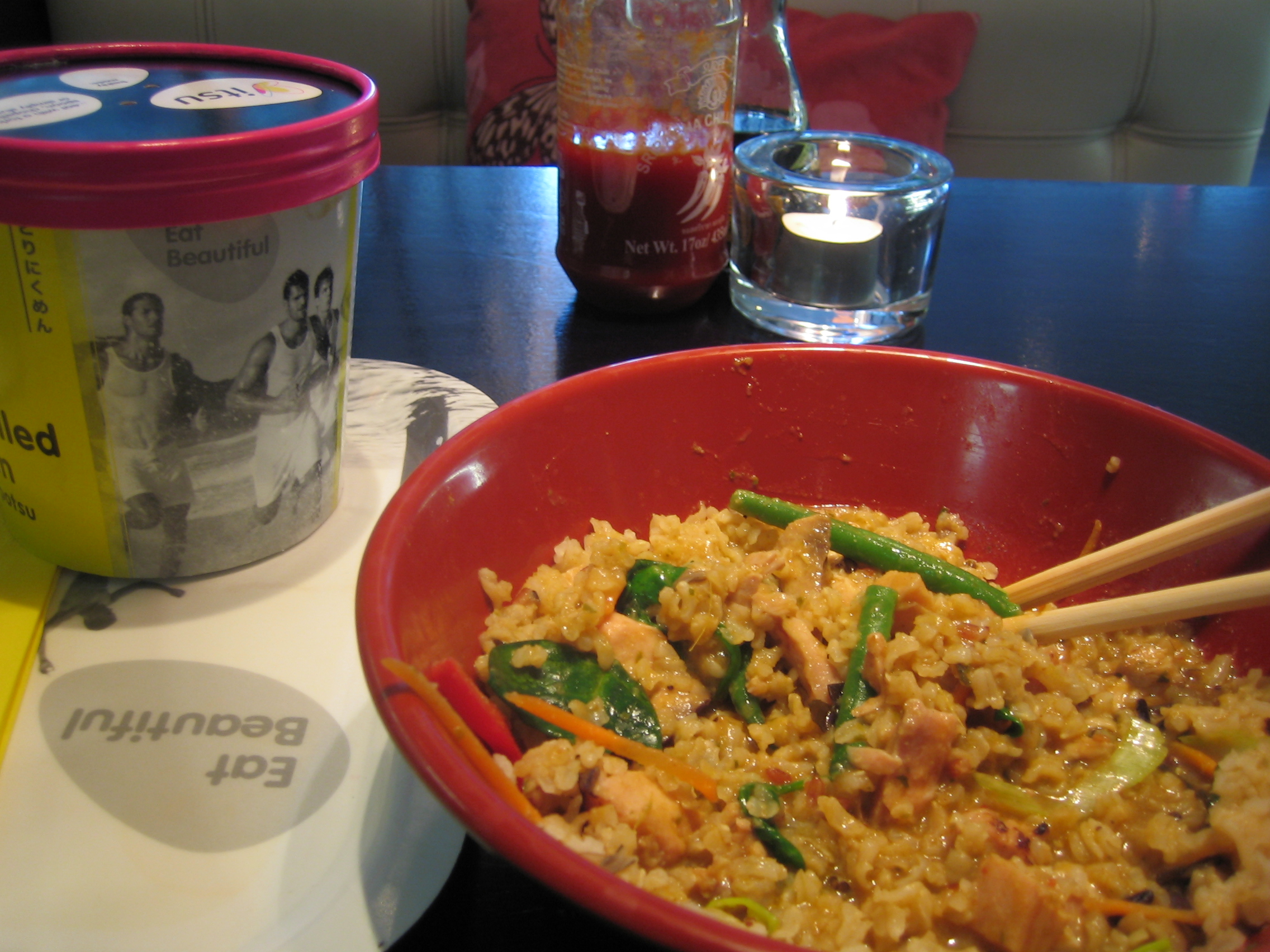 diet might be slightly easier here, but I was mistaken and should have been more aware of watching my veggies! I asked about wheat but thought that I could perhaps pick out any vegetables that were not appropriate for the diet, I forgot about spring onion being a staple item. The green parts are OK, but the meal came with all parts of spring onion, cut small, which was impossible to pick out making it quite an issue really. So failed here big style and I knew I had as soon as the dish was served and I could actually see the problem. I also noted after I had ordered that the list of vegetables were on a notice board behind the service area, perhaps I should have been more vigilant, but I had been out all day so I was really tired. I was annoyed with myself but I suppose we can put this down to a learning experience. I am also wondering why most of the noodles available in the UK are wheat based? Surely you would imagine that as rice is the main carbohydrate in the east that rice based noodles would be more available, despite thorough searches at supermarkets the majority of noodles are based on wheat. Perhaps this is because our main stable grain is wheat – does anyone else have any ideas as to the reason for the lack of rice based noodles? Rice based noodles can be purchased from Chinese supermarkets and health food shops if you need to have them.
Category: Digestive Health
Posts relevent to Digestive health
Breakfast – Low FODMAP
I have enjoyed staying at Bankfield House and although i t was a little noisy up till about midnight, I really have no complaints to make about the room or facilities. The breakfast was the usual affair of cooked English or continental and a good choice was available. To follow a Low FODMAP theme I chose porridge, a banana, 1 tomato, bacon, egg & hash browns. Again this would not be my normal choice but I did enjoy it – I haven’t realised how much wheat I actually include in my diet until you begin to have to make alternative choices. When on holiday we usually eat a large breakfast and then go on till the evening meal, it is true that to breakfast like a king really sets you up for the day. I was so full that I even saved my banana for later.
I decided to go to the Pre-Raphaelite exhibition at the Tate Britain, no reproduction of any of these paintings can every do them justice as it is the light and reflection needs to be

seen to be really appreciated. This was an excellent exhibition, but I have seen some of the paintings before in Manchester Art Gallery Most where most major artists are represented, including the great Pre-Raphaelites, Dante Gabriel Rossetti, John Everett Millais and William Holman Hunt. We are lucky in Manchester to have these paintings available most of the time but some of them, one is ‘work’ by Ford Madox Brown, will have been loaned to the Tate for their exhibition. If you are in London and feel like visiting, I would recommend it!
http://www.tate.org.uk/whats-on/tate-britain/exhibition/pre-raphaelites-victorian-avant-garde
Related articles
- Britain’s ‘first modern art movement’ in Tate show (timesofmalta.com)
- Brian Sewell on Pre-Raphaelites: Victorian Avant-Garde at the Tate Britain (standard.co.uk)
The non Moroccan eat – FODMAP free
 My first eating out Low FODMAP and I chose a Moroccan restaurant next to the hotel. Felt this might be a challenge – but I’m always up for that! My choices were a little restricted but I chose a plain meat dish, I asked the waitress what the fish dish of the day was, to which she replied there wasn’t one, so a steak was the choice to have, she informed me that this would be served with plain salad leaves and chips.
Now this is not what I would normally choose but needs must for the experiment so I said this is what I would have. It was actually really nice and the chips were thick cut and still had their skin on adding to the fibre content of the meal. The leaves were undressed and included a full grilled tomato. The dish also included a sauce, which was served in a separate dish so could be avoided, probably would contain at least onion and garlic, but perhaps I should have asked. Now for your sake ;-), I also decided to have a sweet to see how easy this would be, I didn’t have much choice as the dishes included plenty of pastry and baklava, I chose a chocolate coated meringue. This was huge, a veritable titanic iceberg! What utensils do you think they provided to eat this with? A knife and fork, yes, really! A real effort had to be made to prevent it from being propelled across the restaurant. More went on the floor than in my mouth, probably for the best – very undignified, but lots of fun! I only managed about a third of it in fact, along with my really lovely mint tea. A nice meal, perhaps not what I would normally choose, and not Moroccan, but it was more than acceptable and would mean that I could eat out FODMAP free, should I wish too.
Related articles
- Best Moroccan Recipes (moroccotomorrow.org)
London, clockwatching and fermentable carbs – oh my!
 It’s only a dietitian or perhaps those people with gut disorders who will understand the title to this post! This week I am in London to attend the Low FODMAP training by Kings – attended a short one day course in 2009, but much more knowledge has been acquired since then and this is the first time I have had enough free time and available funds to be able to attend the complete course.
I was very surprised on my last visit to find that the loo’s at both Manchester Piccadilly and Euston are 30p!!!! What happened to spending a penny? Hyperinflation is how I would describe it, although perhaps I shouldn’t be surprised at that, but at least no increases since my last visit. It does somewhat grieve me, as you really don’t have much choice in the matter when you need to go. Perhaps my insistence on arriving at stations early is the problem here, as I then have a drink to waste a bit of time and then need to empty my bladder. If I attended at the time the train was due I could wait till I boarded perhaps, but this would not make travelling any easier. I am rather a stickler for timekeeping, worse probably than John Cleese in Clockwise, so I insist on arriving well before the time I need to! Oh well, you don’t need to hear about my frustrations.
I don’t normally advocate any companies as part of my practice but I will tell you that my room rate was £29.00 per night at the London School of Economics, Bankfield House – this residence is not available in term time as it is student accommodation however I am in the centre of London for the next four days and I doubt very much you could get cheaper accommodation. It is really worth looking at various colleges for out of term time accommodation. I will let you know how I get on and what the room is like, I suspect I may get disturbed at all hours, but only time will tell. It certainly is worth considering. I am now in a cafe with free wi-fi, enabling me to write this post at will, it has been a surprise to me how much reliance I now have to access to the web. I am really looking forward to my break in London, although as those of you who followed me on my last gluten-free London trip will be aware, I always feel slightly claustrophobic in cities. I will also try to include some foodie aspects of my visit, so you don’t get bored – perhaps we should concentrate on low FODMAPs this time, as this is the main reason for my visit. Although I do suspect that this is going to be somewhat more of a challenge that the gluten-free diet, but we will see!! The following posts will be written in retrospect as I do not have that much free time to spend on blogging – or funds to buy countless drinks to justify my wi-fi use!
Autumn thick warming roasted carrot and pumpkin soup, lactose free, milk free, egg free – vegeliscious!
Roasted carrot and pumpkin soup
600g peeled carrots, cut into 4 lengthwise
500g pumpkin
1 tablespoon of garlic infused olive oil
1 teaspoon of turmeric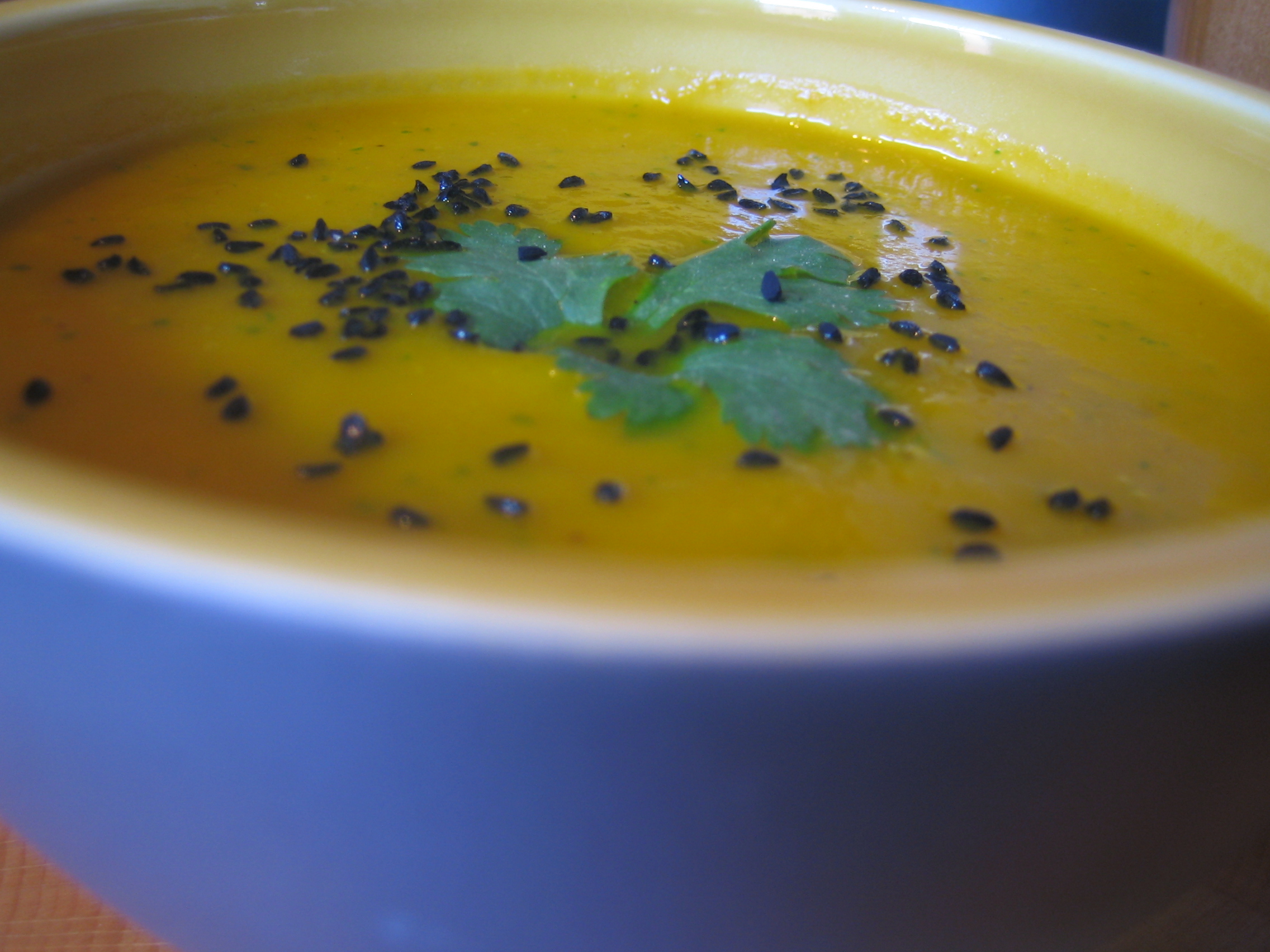
1 teaspoon of cumin
1 teaspoon of coriander
1 teaspoon of ground ginger
1.2 litres of water
small bunch of coriander leaves (depends how much you like the taste.)
Salt & pepper
coriander leaves and nigella seeds to serve
Method
Peel and slice carrots and pumpkin and place in a roasting tin, pour in the olive oil and coat the vegetables well. Sprinkle on spices and mix well.
Roast till the vegetables are soft in texture.
Place in a food processor or blender, add the other ingredients and blend well.
Warm the soup again then serve with a sprinkling of nigella seeds and coriander leaves.
Serves 6
(approximately per serving)
Kcal 67
Protein 1.2
Fat 2.9
Carbohydrate 9.0
Fibre 2.8
There is some debate as to whether pumpkin is safe for the FODMAP diet – it contains mannitol – amount varies on where it is grown, the one I used was grown within 10 miles of home. If you have problems with pumpkin, or are on a FODMAP exclusion you could replace the pumpkin with more carrot and this should work just as well.
Beans, beans are good for your heart…………fill in the rest!
You may have heard the following rhyme,
Beans, beans are good for your heart – well so far this is true they are full of soluble fibre, soluble fibre reduces cholesterol levels and lowers the risk of blood clots preventing heart attacks and strokes.
The more you eat the more you f****, again some real truth here.
The more you f*** the better you feel, well no actually, beans and pulses are known for causing intestinal gas and this can cause havoc with people who have IBS, increasing the level of pain felt and generally making life really miserable. Beans and lentils (pulses) contain a type of carbohydrate called raffinose, this is indigestible by everyone, but with people who have IBS the bloating that results stretches the bowel wall and causes pain. I don’t really need to explain f*** do I? I’m much too polite, I’m afraid.
So let’s have beans for every meal – erm, again possibly not, if you are pron e to bloating and pain after eating them.
BUT I MISS BEANS! I’M VEGETARIAN – BEANS ARE MY PROTEIN AND IRON! 😦 HELP!
You should only exclude foods that are actually causing problems, variety in your diet is very important. Good sources of protein for vegetarians are quinoa and quorn and iron can be found in dark green leafy vegetables – ensure you have a SMALL glass of fresh orange to aid the absorption into your body, only if you are not intolerant of fructose. Ask to see a dietitian if you require more personal dietary advice here.
Is there anything I can do to make this food a little more tolerable?
Well possibly.
When buying dried pulses (lentils and beans) please ensure you use them up quickly – leaving them in your cupboard for more than a year really doesn’t help, the longer they are stored the tougher they become. They then require more soaking and boiling to make them more digestible. Ensure the surface is without shriveled skin and the colour is bright. Store your dried beans in a sealed container in a cool dark place.
Soaking is then required, don’t add anything to the beans but water and change this a few times during the soaking process, if you can. Don’t be tempted to add salt or sodium bicarbonate to the beans, salt will inhibit the soaking process. You will need to soak the beans at least eight hours or preferably overnight and rinse the beans after soaking prior to cooking.
Cooking times vary depending on the age and water hardness, again before adding the beans to another dish don’t be tempted to use the water for stock as this does contain more raffinose. See the link at the bottom of the page for a useful information leaflet from Pulse Canada on cooking times for beans. Don’t add acidic foods to the beans whilst cooking such as tomato, vinegar or lemon juice as this makes the cooking process longer.
Tinned beans need to be rinsed before use, again don’t be tempted to use the liquor to add to other dishes – the beans have been cooked in the tin and not given the same treatment. Some of the cheaper tinned versions can be a little tough, necessitating longer cooking time to avoid excessive wind – buying cheaper versions may be false economy if you need to cook them for longer!
A word of warning about kidney beans, cannellini beans and broad beans, they all contain phytohaemagglutanin a protein that if consumed in large amounts is a toxin, it is found in large amounts in kidney beans. It is denatured by correct cooking. Tinned kidney beans are better to avoid the risks, but do rinse them well before using them!
Some information was found about adding a piece of seaweed (Kombu) to the beans during cooking to aid with reducing raffinose content of beans, lots of un-referenced information on the web. Kombu was suggested to contain alpha galactosidase an enzyme that digests raffinose. I have, despite a good hunt on the internet and research sites, been unable to find the source of this information, so I am actually unsure if this does work – any help here from food technologists would be gratefully received! Please reply!
Make your own baked beans!!
Gluten free, dairy free, vegetarian.
500g dried haricot beans
20 sprigs of fresh thyme
2 medium potatoes
400 ml passata
salt (not too much!)
Soak the beans for at least 16 hours with water, change water at least four times.
Peel potatoes and boil till soft, mash.
Cook the beans for 30-40 minutes or until soft in fresh water, then drain.
Add the potato to the beans and the passata, fresh chopped thyme and a small amount of salt. Cook for ten minutes – eat & enjoy!
See link for lots of useful info on pulses!
http://www.pulsecanada.com/food-health/fact-sheets-resources
 Clinical Alimentary